
Our Purpose
A mission to mainstream Sankhya — the axiomatic natural science — and help people everywhere think as nature intended.
Our mission
Imagine Nature's Wheelwork exists to bring Sankhya — as decoded in our own time by engineer G. Srinivasan — into the mainstream of learning. Sankhya is not a belief system; it is a rigorous, axiomatic account of how nature builds everything, from the first vibration to the fully formed cosmos.
Our goal is simple: to make that account clear, visual, and usable — for students, teachers, and every curious mind — while honoring both the ancient source and the modern science that confirms it.
We bridge East and West under one banner: the laws of nature and of nature's God.
The science
Sankhya is the original natural philosophy set down by the sage Kapila — an axiomatic natural science that derives the workings of the universe from a small set of self-evident first principles, much as geometry derives from its axioms.
Its central idea is the substratum (in Sankhya, Akasha): an elastic, holographic medium of space — a boundless "solid" — upon which all manifestation occurs. It is not empty but full of perfectly balanced, dynamic activity, which is why it is so hard to detect. Matter, charge, spin, light, and gravity are not separate mysteries but different motions and strains within this one medium. What looks like empty space is in fact a vibrating fabric, and every phenomenon is a standing pattern in its wheelwork. In modern discussions this same medium is commonly referred to as the Aether or space-time — but here it is treated as authentic, testable natural science, not classical ether.
Understood this way, the discoveries of Western physics — refraction, relativity, electromagnetism, quantum behavior — line up naturally with the insights of the East. The same mechanism explains them all. That is why the initiative treats these not as competing worldviews but as one continuous account of truth, life, and growth.
The source
Every scientific claim in this series is drawn exclusively from G. Srinivasan's transliteration of Maharishi Kapila's ancient Sankhyakarika — a closed axiomatic system capable of deriving measurable physical constants without prior assumptions. His decades of work are published and archived at kapillavastu.in, the primary reference source for the science behind Imagine Nature's Wheelwork.
The storytellers
Four voices carry the story of nature's wheelwork across time and disciplines.
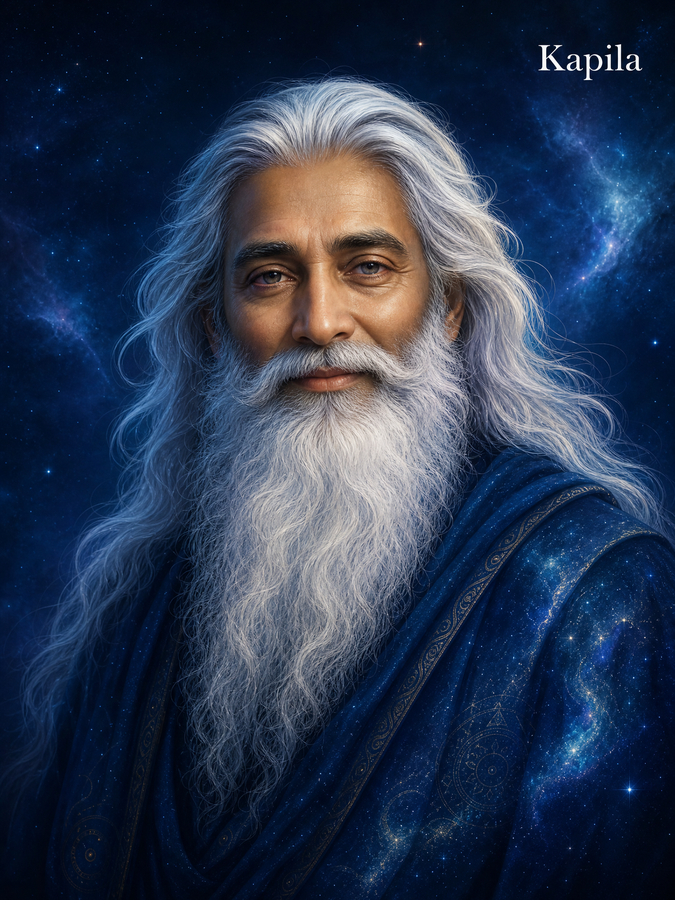
The Ancient Sage
The original Sankhya philosopher and natural scientist. Kapila first mapped the axioms that describe how the substratum gives rise to all things. He speaks with the calm authority of someone who has watched nature closely for a very long time.
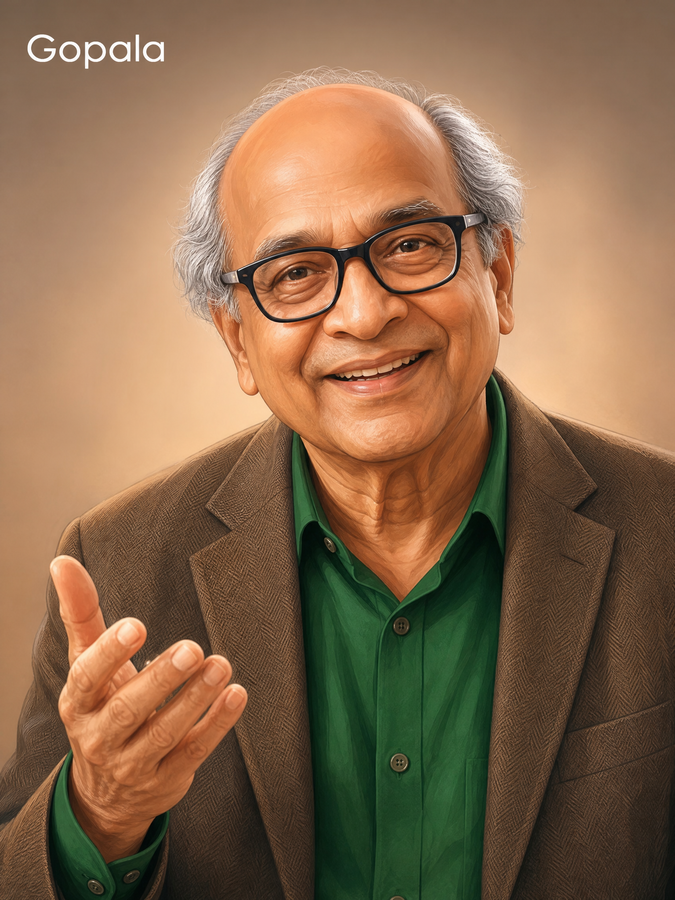
The Modern Engineer
The engineer who re-decoded Sankhya's 68 axioms over four decades of patient work. Gopala translates ancient first principles into the language of modern physics and mathematics, showing that rigor and wonder belong together.

The Self-Taught Collaborator
Gopala's collaborator, largely self-taught and endlessly curious. Neil prefers to learn one-on-one, testing every idea with sharp questions. His conversations model exactly how a newcomer can reason their way to understanding.

The Curious Newcomer
A curious teenager and the reader's companion on the journey. Sophie asks the questions we're all thinking, and her fresh-eyed wonder turns every discovery into an invitation to explore further.
How it all fits together
Freedom First Pathfinders (FFP) is the organization behind this work — an unincorporated private body whose purpose is to discover higher truths and empower living men and women to assume among the powers of the earth the separate and equal station to which the Laws of Nature and of Nature's God entitle them. FFP pursues its mission through several distinct lines of effort, or initiatives, each with its own tools and audience:

An initiative and online platform for growth, community, and the foundational ideas of freedom. It is one tool through which FFP carries out its mission.

This educational book-and-simulation initiative — another tool through which FFP brings Sankhya, the axiomatic natural science, to young minds and lifelong learners.
Science of Freedom and Imagine Nature's Wheelwork are two of FFP's initiatives today — and more may follow. The organization is the hub; each initiative is a tool serving the same larger purpose.
A symbol of the mission
Two faces, one philosophy — the axiom of freedom on one side, the compass of purpose on the other.

The front bears the Freedom mark and the axiom 1/x = 1+x signifying rhythmic balanced interchange, encircled by the words of Swami Vivekananda "Because freedom is the first condition of growth." This side represents the Science of Freedom — the founding idea that a free mind is the starting point of all real growth.
"The question was practically this: 'What is this Universe? … From what does it arise? … Into what does it go?' And the answer was: 'In freedom it rises, in freedom it rests, and into freedom it melts away.'"
— Swami Vivekananda, Maya and Freedom

The back is a compass with four quadrants, each pointing to one of the Pathfinder's four callings:
"Liberty first of all, then discipline and harmony then development of all the talents."
— OAHSPE
Join us
Connect with fellow explorers, follow the series, and help mainstream the science of how nature actually works.