
Teach As Nature Intended
Help your students see the patterns beneath everything. We're building resources that make nature's wheelwork clear, hands-on, and unforgettable.
Find what you need
Start with the essentials, then follow the teaching notes book by book as your learners progress through the series.
Why teach with INW
Each chapter and simulation maps to core STEM concepts — patterns, ratios, waves, fields, and forces — so it slots naturally into your existing science and math units.
Interactive simulations and guided investigations turn abstract physics into something students can manipulate, predict, and reason about for themselves.
Connect with fellow educators, share lesson ideas, and get answers from the people building the initiative — through the Freedom First Pathfinder community.
Your guides
Gopala and Neil model the kind of patient, first-principles thinking we hope every classroom can share.
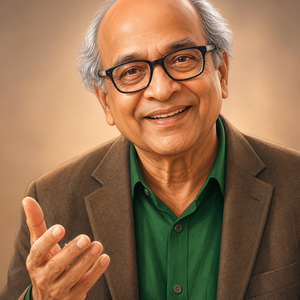
The modern engineer who re-decoded Sankhya's axioms over forty years. He shows how rigor and wonder belong together.

A self-taught collaborator who learns best one question at a time — a natural model for classroom dialogue.
Start here
Before bringing nature's wheelwork into your classroom, it helps to understand what Sankhya actually is. These two foundational readings introduce the pre-Vedic axiomatic science of Maharishi Kapila — transliterated for the first time in its authentic scientific meaning by engineer G. Srinivasan — and the “logic of counting” at its core. Begin with these to see why a 32,000-year-old framework speaks so directly to the open questions of modern physics.
PDF · 10 pages · G. Srinivasan
A clearly organized primer that frames the crisis in modern physics — the EPR paradox, dark matter and energy, Hubble expansion, and the undetectable aether — and shows how Sankhya's single-parameter, combinatorial framework resolves each in turn. An ideal at-a-glance map of what makes Sankhya unique and how far its predictive reach extends, from the masses of stable particles to planetary orbital radii.
PDF · 21 pages · G. Srinivasan
A concise scholarly overview of Sankhya theory together with its axiomatic mathematical proof. It sets out the criteria for a genuinely complete unified theory, introduces the substantial and perpetually dynamic nature of space, and explains the Perpetual Harmonic Oscillatory (PHO) state and the 68 Sanskrit sutras — showing how counting interactions, rather than clock time, forms the real basis for evaluating every natural phenomenon.
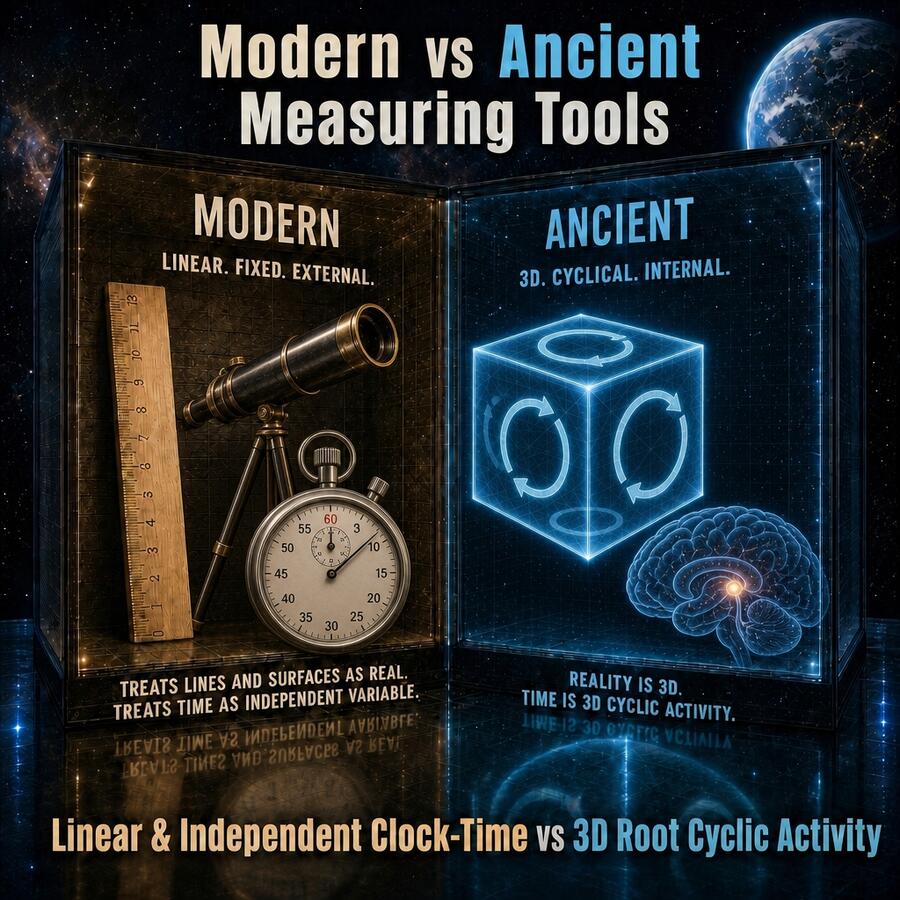
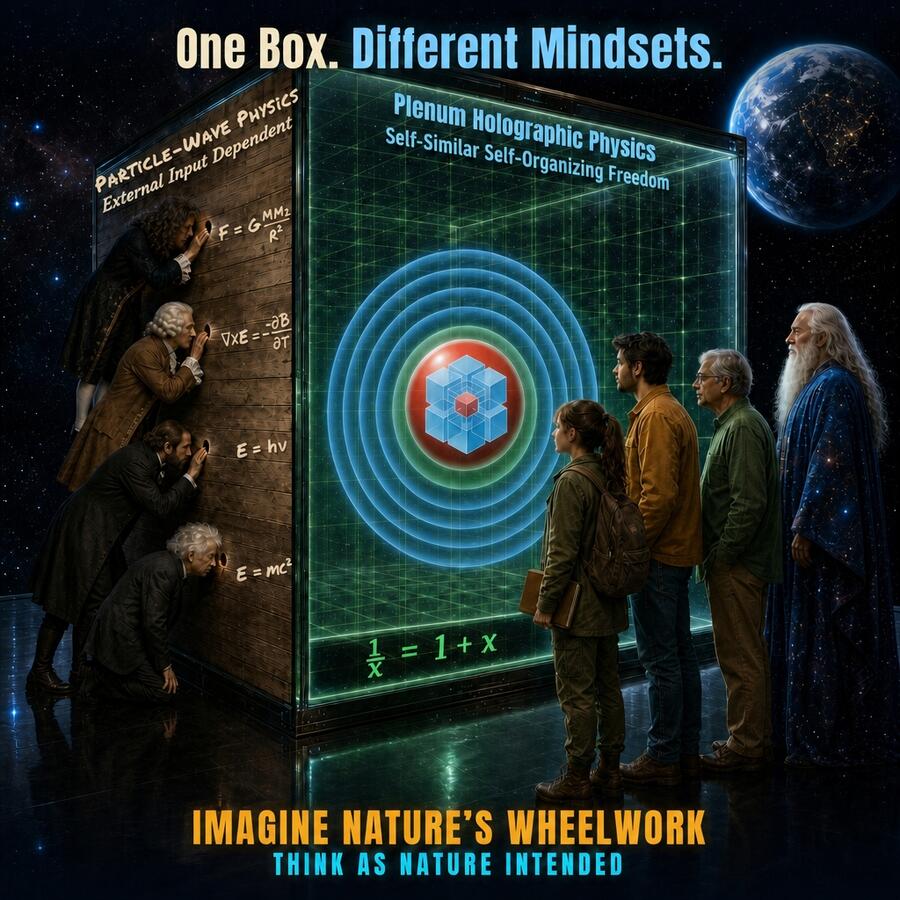
Already know Newton, Planck or Einstein? Schauberger or Russell?
Whether you come from the formal world of quantum mechanics and modern physics, or from the nature-inspired insights of Schauberger and Russell, these two reports offer a bridge into Sankhya. One speaks to physics-trained minds; the other honors the less credentialed but deeply observant tradition. Both show how Sankhya completes the picture — physics whole, not negated.
PDF · 49 pages · For physics-trained educators
Doorway for the formal science audience. A rigorous bridge that honors every confirmed experimental result while showing that a complete axiomatic foundation exists to explain why the constants are what they are. Addresses the medium (aether), fundamental constants, particle physics, cosmology, and quantum mechanics. Its axiomatic derivations are reported to agree with measured values to 99.3–99.99%.
PDF · 35 pages · For nature-first thinkers
Doorway for the nature-inspired audience. A comparative exploration of three frameworks — Sankhya & Sanatana Dharma, Viktor Schauberger, and Walter Russell — that independently arrived at the same insight: nature's laws are discoverable, harmonious, and life-giving. It traces their shared vision of a living substratum and the historical pattern by which each was marginalized.
Book-by-book teaching notes
The series is a deliberate progression — observe, reason, derive, create. Each book below includes the big ideas to teach, classroom activities to try, and prompts for discussion and assessment. Start with Book 1 and move forward as your students are ready.
Now live: the Discovery Zone is open — hundreds of interactive simulations, live constant & particle derivations, hands-on sandboxes, and the Sankhya reference guide are all ready to explore in your browser today.
Book-specific lesson plans, worksheets, and answer keys mapped to each title are still in active development — register your interest below and we'll send them the moment they're ready.
Book One · Teaching Notes
The foundation of the whole journey. Students learn that observation is the first scientific instrument — noticing patterns (Fibonacci sequences, the golden ratio, spirals, waves) and asking why they exist rather than memorizing that they do. Best suited to ages 13–18, and an accessible entry point for any curious learner.
Book Two · Teaching Notes
Students move from observing patterns to proving why they must exist. Through a chain of logical deductions they reach a startling conclusion — space cannot be empty; it must be a filled, dynamic continuum with measurable properties. Ideal once learners are comfortable with Book 1's observation habits.
Book Three · Teaching Notes
The series turns from reasoning to engineering. Working through Kapila's 68 axiomatic Sutras, students derive the constants of physics as consequences rather than inputs — including the speed of light as nature's own timeclock and gravity reframed as a "missing interactive count." Best for learners ready for more formal derivation.
Book Four · Teaching Notes
The culminating volume. Students apply the full framework across chemistry, biology, music, and astro-dynamics — then make the final turn inward, examining consciousness itself and arriving at Kaivalya. Science shown as generative, not merely descriptive: once you can derive the rules, you can compose with them.
Get on the list
Click below to send us an email — tell us a little about your classroom and we'll notify you the moment educator resources are ready.
We'll only use your details to share educator updates. No spam, ever.
Prefer to connect now? Join the community ↗